
Press and line data for plastics and packaging
Press and mold performance by shift, scrap by cause and energy per part, counted from shots and active cavities rather than from the tally at the end of the shift.
For: Plant managers, process engineers, molding supervisors and quality leads
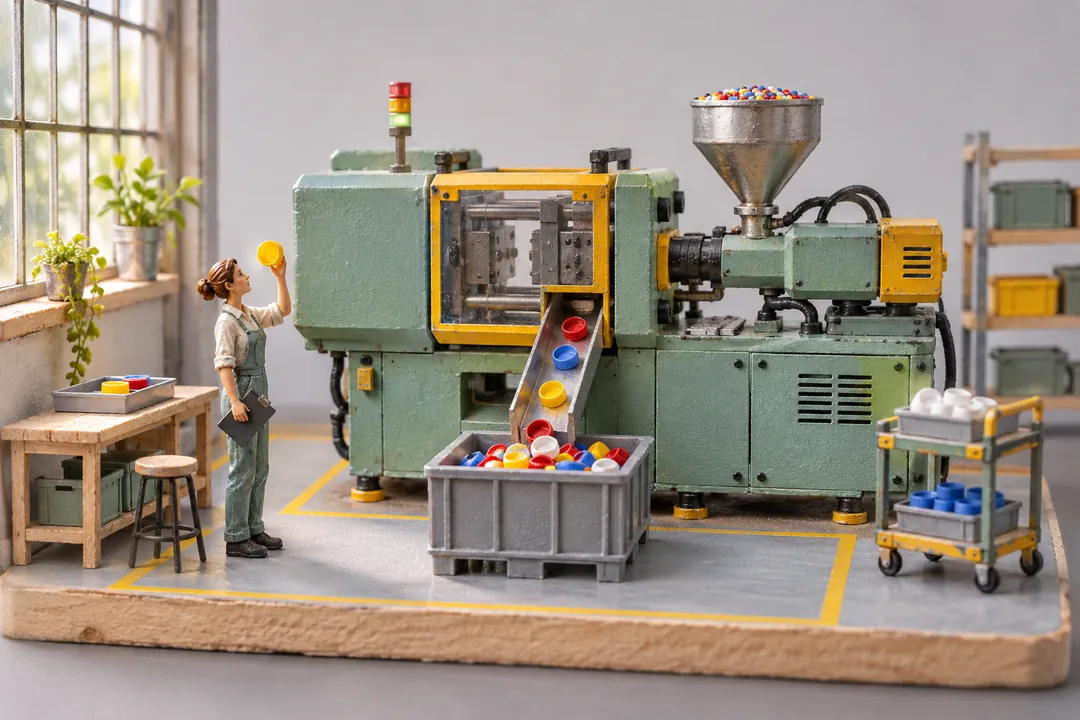
In a molding plant, output is arithmetic: shots times active cavities, minus scrap. The trouble is that every term moves. A cavity gets blocked off and stays that way for weeks. The cycle drifts half a second slower after a material change. Start-up scrap after a stop goes into the regrind bin and never reaches a report. By the end of the month the parts count is short, and nobody can say which of these cost the most.
OpenGXT builds hosted software that reads presses and their auxiliary equipment, reports each term by press, mold and shift, and keeps it running after go-live. It covers injection molding, extrusion and converting lines, and the packaging equipment that follows them.
What the software reads
For injection presses:
- Shot count and cycle time, from the press controller or from a mold-open signal.
- Mold and cavitation: which mold is in the press, how many cavities it has and how many are active today.
- Process temperatures: barrel zones and mold temperatures from the press or the temperature controllers, logged by minute or by shot.
- Dryer status: running, alarms, and dew point or hopper temperature where the dryer reports them.
- Reject signals from the press or a robot, and scrap entered by the operator with a cause.
- Electricity from a meter on the press or on the panel that feeds it.
For extrusion and converting lines the unit changes. Output is read from line speed and, where one exists, a gravimetric feeder or a scale. Mold changes become die, roll or job changes, and scrap is recorded as start-up, edge trim and off-spec material.
Questions molders ask first
Can it read our presses’ controllers?
Each press is checked during the equipment and data survey. If a press advertises a Euromap or OPC UA interface, we test it on that press; we do not list an interface as working until we have read real values from it. Older presses can still provide a cycle signal, a mold-open signal and an alarm output through a small I/O module, wired by your electrician or a licensed contractor. Temperature controllers and dryers can often be read over Modbus, and that too is confirmed press by press. The machine connectivity service covers the gateway and the signal inventory.
Can we see scrap by mold?
Yes. Scrap is recorded against the press, the mold, the material and the shift, with a cause from your own scrap codes: start-up, short shot, flash, splay, contamination and so on. Where a reject signal exists, the count comes from the machine and the operator adds only the cause. Because temperatures are logged on the same timeline, an engineer can see what the process was doing when a run of scrap started. The software shows the data; the root cause is still your process engineer’s call. Part weights from a check scale can be charted alongside, using the control charts in quality data.
Can we see energy per part?
Yes, once the press or its panel has a meter. Energy monitoring divides metered electricity by good parts, or by kilograms of good output using the part weight, for each press, mold and shift. Consumption while a press sits idle between jobs is shown separately, so a press left heating overnight is visible. The energy per unit calculator shows the arithmetic.
Molds, standards and mold changes
Each mold carries its standard cycle time and its cavitation in the data dictionary, so performance is always measured against the mold that is actually in the press. When a cavity is blocked, the active count is changed on the screen, the change is logged, and the parts count follows it. Mold changes are timed from the last good shot of one mold to the first good shot of the next, and can be split into the change itself and process start-up. Shot counts per mold can also drive mold maintenance reminders through maintenance software.
Example (fictional). A fictional custom molder runs Press 7 on second shift, 14:00 to 22:00 (480 minutes, with a 30-minute planned break), making closures in an 8-cavity mold with a standard cycle of 12.0 seconds. One cavity was blocked off after a damaged core pin, so the mold is running on 7. The press stops twice, for a dryer alarm (22 minutes) and a wait for the mold technician (28 minutes), leaving 400 minutes of run time. The shot counter reads 1,920, an average cycle of 12.5 seconds (400 × 60 ÷ 1,920). At 7 cavities that is 13,440 parts. Scrap is 220 start-up parts after the dryer stop and 180 short shots flagged by the robot’s reject signal, 400 in total, so 13,040 parts are good. At the standard cycle and full cavitation, 400 minutes would have produced 2,000 shots and 16,000 parts. Of the 2,560-part gap, the blocked cavity accounts for 1,920 (one cavity on every shot) and the slower cycle for 640 (80 fewer shots at 8 cavities). The press meter shows 72 kWh for the shift: 5.5 kWh per 1,000 good parts, or 2.2 kWh per kilogram at a part weight of 2.5 grams. The report turns the mold repair into a production decision: the blocked cavity cost three times as many parts as the slow cycle.
What you provide and what you receive
| You provide | You receive |
|---|---|
| A press list with controllers and auxiliary equipment (dryers, temperature controllers, robots) | A signal inventory for each press |
| A mold list with cavitation and standard cycle times | Press and mold performance by shift, against standard |
| Materials, part weights and your scrap codes | Scrap by cause, mold and shift |
| Meters on presses, or the panels that feed them | Energy per part or per kilogram, by press and mold |
| Mold change standards | Mold change times against standard |
| Setup technicians and supervisors on each shift | Onboarding, quick guides, hosting and support after go-live |
Starting with one group of presses
A pilot usually covers one group of presses, or one extrusion line, chosen because the plant already has questions about it. The written pilot plan names the presses, the molds, the signals and the acceptance measures: do shot counts match the press counter, do part counts match what was packed, and does the scrap report use your codes. If they do, the same model extends to the rest of the floor. See how production monitoring builds the shift report and how a pilot line is set up.
Start with one line.
Tell us which line you want to understand and the question you ask after every shift. We reply with questions or a time to walk it with you.